Local Spirits, Loose Threads: A Folkloric Halloween Scheme That Belongs to Your Postcode
Walk into almost any supermarket in October and you will meet the same cast: the screaming mask, the severed hand, the plastic axe. It is loud, it is imported, and it has absolutely nothing to do with the island you live on. Which is a shame, because British folklore is genuinely unsettling in a way that gore never quite manages. It is quiet, it is local, and it knows your postcode.
This is a guide to decorating that leans into all of that. Nothing gory, nothing tacky, and nothing you cannot source from a market stall, a charity shop or your own back garden.
Start with your own map, not a moodboard
The trick with a folklore-led scheme is that it should feel like it belongs to a place. Before you buy a single prop, work out what actually haunts your corner of the country. East Anglia gets Black Shuck, the great black dog said to have stalked the coast and, legend has it, left scorch marks in the doorway of Blythburgh and Bungay churches in 1577. Yorkshire has the barghest and the church grim. Wales has the gwyllgi, Scotland the cù sìth, a green-furred hound of the Highlands. Lancashire and Greater Manchester claim the boggart, that sulking household nuisance of a spirit, remembered in place names like Boggart Hole Clough.
You do not need to render any of them literally and you definitely should not. The whole point is suggestion. A shape, a symbol, a hint of something at the edge of the light.
The cast: five motifs that do the heavy lifting
- The black dog. A flat silhouette is all you need: card, plywood or a painted shape on a wall.
- Chalk marks. Apotropaic or witch marks, the scratched symbols found near doors, windows and hearths in old houses. Real examples survive at National Trust properties up and down the country.
- The corn dolly. A harvest figure of straw and ribbon, traditionally the last sheaf of the season. Odd, beautiful, faintly unsettling in a lit corner.
- Bramble and thorn. Grown blackberry canes are the classic hedgerow gloom, and blackberries themselves come with a folk warning about picking after Michaelmas.
- Rowan and thread. Rowan has been hung over doorways against ill fortune for centuries. A red thread does the same job in miniature.
Corn dollies, chalk marks and other small heresies
A corn dolly is the easiest of these to make and the one guests will ask about. Raffia or long straw, a bit of patience, and a YouTube tutorial will get you a simple spiral or lantern shape in under an hour. Craft shops such as Hobbycraft sell raffia by the bundle; a country show or a local agricultural supplier will do you dried straw for very little. Skip the glitter and the googly eyes, obviously.
For chalk marks, do not draw on your walls. Paint or chalk on small slate tiles, roof slates from a reclamation yard, or circles of MDF, then prop them on shelves or stand them in a hearth. A handful of marks, repeated, at low height around a room reads far more convincingly than a single showpiece.
Brambles, rowan and the case for a foraged garland
A garland of trailing blackberry and thorn, wired along a mantel or the front of a sideboard, is the cheapest way to make a room feel like the edge of a wood. Twist two lengths of dark florist wire together, bind short sections of bramble and ivy along it, and finish with black or oxblood ribbon. Wire is available from any craft shop; the greenery is free.
Foraging etiquette matters. Take only what is loose and abundant, never uproot anything, and stay clear of nature reserves and land where picking is restricted. Give everything a rinse and a good shake outside before it comes in, because you are not the only thing that likes a hedgerow.
Pulling it into one room without turning it into a museum
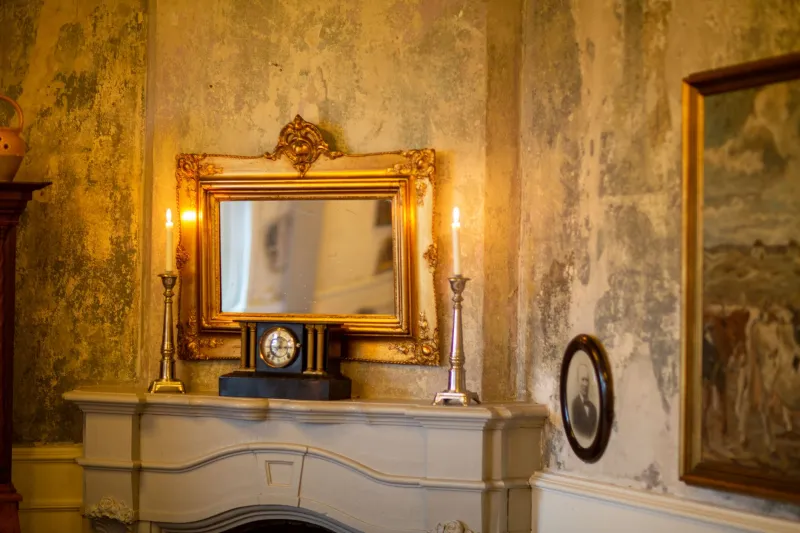
The mistake people make with folklore styling is treating it as a collection. It should be a scheme with three layers: a base (aged linen, dark wood, beeswax, low warm light), a motif layer (the garland, the silhouettes, the chalk tiles) and a single deliberate oddity, such as a corn dolly in a glass cloche or a rowan sprig tied to a door handle.
Keep the palette tight. Charcoal, oat, oxblood, moss and the pale amber of candlelight. Anything bright or glittering breaks it.
Shopping for the folklore shelf
National Trust and Historic Houses gift shops are full of plain, well-made things that suit this look. Museum shops are even better. Local craft markets and makers on Etsy will supply you with a hand-tied corn dolly or a lino-cut hare. Charity shops remain the best source of brass candlesticks, cake stands and old wooden bowls, and Dunelm or The Range will cover the fabric and ribbon side for a few pounds.
Candlelight, safely
This style of decorating is warm by design, so people reach for real flame. Do so carefully. Dried foliage, raffia and brambles are extremely flammable and will go up far faster than you expect, so keep any real candle well away from a garland and never arrange one inside it. Battery-powered tealights and LED pillar candles now look convincing enough that nobody will notice.
If you do use real wax, stand candles in metal or ceramic holders on a stable, non-flammable surface, keep them out of draughts and away from soft furnishings, and never leave a room with one burning. Treat button batteries used in tealights as a serious hazard and keep spares sealed and out of reach of children and pets. Rowan berries and bramble thorns are also worth keeping at height if you have pets or small children in the house.
The takeaway
A British Halloween does not need to shout. It needs a black dog at the edge of the lamplight, a twist of thorn above a doorway and the strong suspicion that something is quietly minding its own business in the corner. That is far more unsettling than a plastic axe, and it is yours.